


Understanding Dyslexia and Its Counterparts
Dyslexia feels so vague for some and unfortunately health insurance and not even all school districts recognize and support this learning challenge. It is oh so real though.
Let's first breakdown a few "types" of dyslexia. It is important to recognize dyslexia can range from mild to severe and present in a variety (or combination) of ways.

You can download the above image as a PDF here.
Breaking down the facets of dyslexia help to also recognize the signs. Please note the below list is not exhaustive and one or two signs do not equate diagnosis.
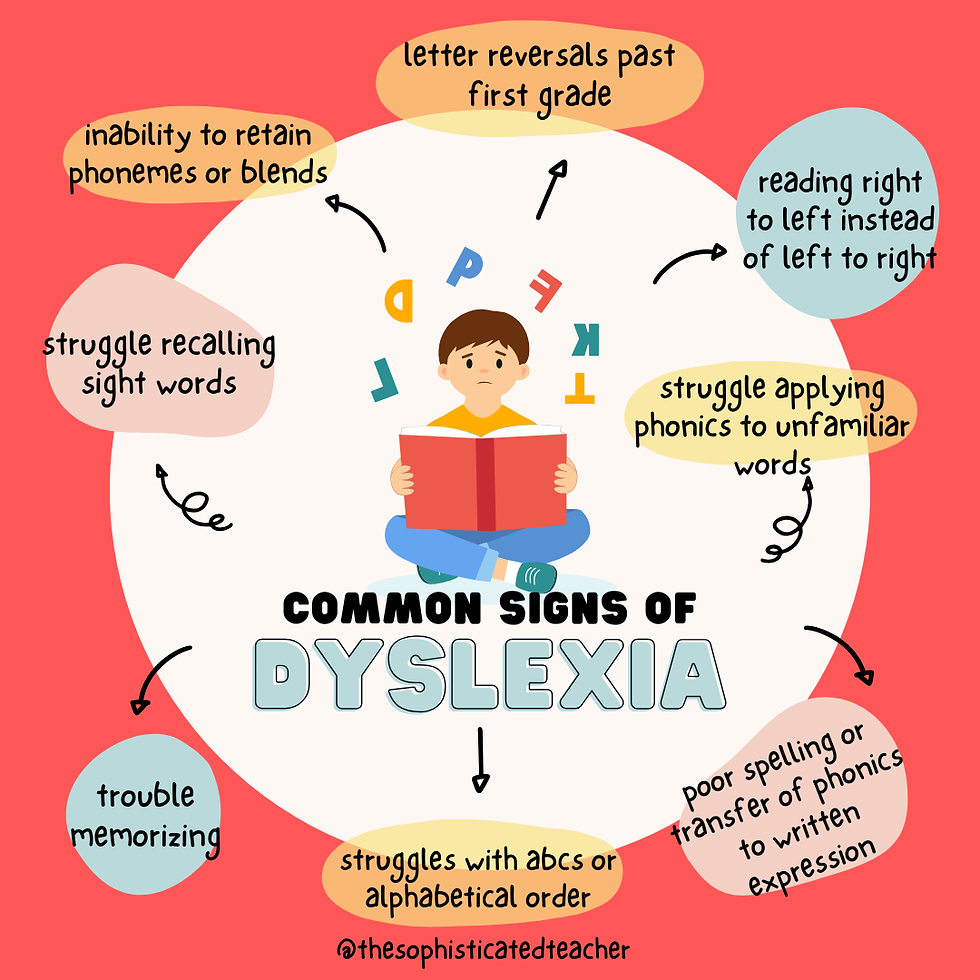
If you suspect dyslexia there are a few things you can do:
Public and Private school: Talk with your child's teacher & escalate to the special educational coordinator for your school if needed. Please do this in writing.
Homeschool: Contact your county's Child Find or special education department for testing (this process varies state to state) or find a local reading specialist, educational consultant, or neurological assessment provider
Any type of schooling: You can always speak with your pediatrician but please know not all pediatricians have screeners for dyslexia but may have referrals. They may have The Colorado Learning Disabilities Questionnaire – Reading Subscale (CLDQ-R)
If you want more insight at home the following assessments can be helpful (it never hurts to equip yourself prior to meeting with professionals):
DORA Reading Assessment (I also provide this service as a neutral party) - This gives an in-depth picture of phonetic ability, sight word recall, and basic reading comprehension. It progresses with the child.
Colorado Learning Disabilities Questionnaire - Reading Subscale (CLDQ - R) is a screening tool designed to measure risk of reading disability (i.e. dyslexia) in school-age children. This screener is shown below. You can score it yourself:

Scoring The Colorado Learning Disabilities Questionnaire – Reading Subscale (CLDQ-R):
One point for never/not at all
Two points for rarely
Three points for sometimes
Four points for Frequently
Five points for Always
Total: __________
Scoring:
Total Score < 16 Minimal Risk
Total Score 16-21 Moderate Risk
Total Score > 21 Significant Risk
Please note this is a guide for the screener, more in-depth screening is needed for formal diagnosis.
If you are looking for supplemental programs at home or a homeschool curriculum, I have a blogpost for you! Check it out here!
I also offer additional testing options: Testing, Consulting, & SEP | SophisticatedTeacher
It is important to know dyslexia does not mean your child will not write, read, or spelling efficiently. As a former teacher and homeschool mom to two of my own dyslexic learners, I can tell you with the right support, curriculum, and consistency great strides will be made!
Check out more on dyslexia on my IG highlight! Including the success of my own child.


Comments